On the personal side, I took the plunge to get engaged we just closed and moved into our 1st home, a life-changing ordeal in itself. I also personally learned that a country doing everything it can to self-destruct that’s $20 trillion in debt sorely needs software to help the drastically under-equipped IRS manage operational claims to chip away at (separate post in itself).
Sponsorship Buddy is rebranding within the next few weeks to encapsulate the force it has become, now directly optimizing workflows for thousands in the brand, agency and rights holder/property space (recently including the San Francisco Giants, who I could’ve garnered multiple rings based on a different life choice made (another post of its own). With a valuation now in the 9 figure range, one could ask how I could entertain usage of my full-time hours going to something else?
The answer? The blockchain.
I also passed up an equitable opportunity with a software behemoth fast approaching IPO and an executive spot with the most elite membership and concierge program in the world involving curation of the most customized VIP global personalized experiences.
After a few weeks spent volunteering, negotiating and absorbing, I signed on to become the #2, C.O.O. & Head of Fundraising for what we believe could be the most compliant blockchain solution in the exploding ICO market. By the way, ICOs (initial coin offerings) have overtaken traditional venture capital funding means and skyrocketed to over $5 billion in funds raised for 2017.
Everyone’s now heard of Bitcoin (the Amazon of the cryptocurrency world), but most don’t understand it or the blockchain. This distributed ledger system promises to change the world by decentralizing everything, from global monetary policies to how transactions are recorded.
There are innumerable roadblocks in the way before that happens, however. Many early ICOs were launched by the likes of 19-year-old Ukrainians arming a cartel without as much as a business or legal backing. While due diligence, transparency and sound legal business principles are on the rise, there is an impending fear of the unknown, especially the SEC coming down to ban and punish those deemed outside of the legal limits. A day of reckoning is in order in today’s new age Wild West.
At OMINEX, sister-company CrowdEngine has the SEC & FINRA compliance nailed. OMINEX plans to offer a wallet to manage such security and other crypto tokens and provide the portal to launch the buttoned-up ICO, funding your dream, world-changing blockchain project.
But first, we need believers to take a chance with us and invest in the most compliant fundraising solution seen to date (while benefitting with us along the way). We could use great Advisors, referral partners and investors to help us build out the vision before we can draft the team.
It’s been quite the heroic comeback story, 2017 vs. 2016 that is.
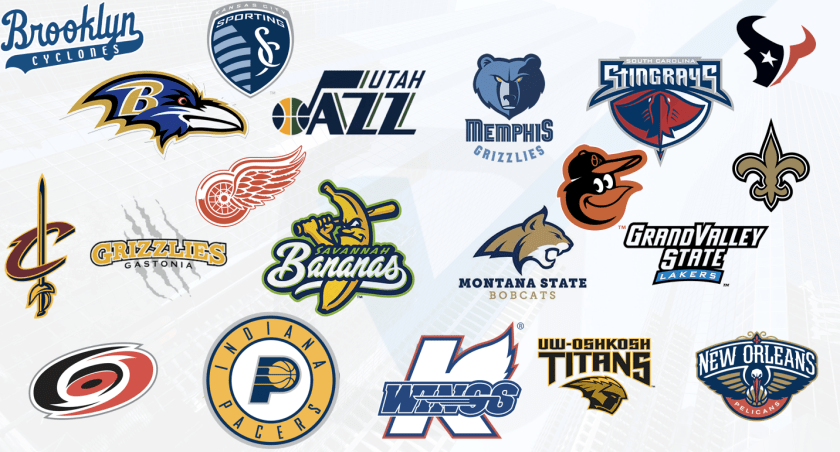
The Cleveland Cavaliers, Detroit Red Wings, Baltimore Orioles, Sporting Kansas City, Indiana Pacers, New Orleans Saints & Pelicans (among others pictured above): what do these represent? All, the latest and greatest clients of Sponsorship Buddy Inc. I, as the lead hunter, should be out celebrating in the streets to land these huge, globally embraced and recognized team brands as clients of our disruptive new platform, right? Not so fast, my friend.
Early entrepreneurial life is not glamorous (nor is the sports industry). Over the past 20 months, I’ve had to learn all kinds of new skills, competencies, and levels of resiliency and discipline. I set out with a goal of transforming the sponsorship industry in much-needed fashion for the better to help create more transparency, streamlined communications, a better client experience and improvements in quality of life. In doing so, I hoped to make my mark as an innovator, disruptor, and difference-maker and put it all on the line to do so (personal life, relationships, financial stability).
Full disclosure, it’s been the most challenging period I’ve had in life and there have been some big ones. While persistently searching out believers in my network, I’ve been aggressively pursuing careers and been so close on fantastic opportunities in sports or tech in Denver, San Francisco and here in Salt Lake City, only to be passed up on at the finish line. My closest contacts have seemingly written me off while it’s been impossible to fight off bouts of despair, depression and not feel like a failure.
One of my key strengths is my resiliency, persistence, and aversion to quitting. I thought the industry would snap up this relatively inexpensive tool but learned that it was going to take completing the marathon to change the game.
Back when we were looking for our 1st major league client after the Utah Jazz (beta customer of ours), I leaned on my former group in the Memphis Grizzlies, who have been notably innovative. In speaking with Mya Donald, activation lead for the team, I said something along the lines of, “I know this is new and daunting, but this can not only put the Grizzlies on the map as a leader in the space, but do great things for your careers.” The Grizzlies bought in, embraced the tool, and four weeks ago, Mya was on-stage as a finalist at NBA league meetings citing us as a key piece to the team’s peer-nominated Relationship Management Program of the Year. To add validation, the winners of the award, the Cleveland Cavaliers, known not only for being runner up in the 2016-2017 NBA Finals, but also for a notable Goodyear Jersey Patch Campaign and innovative 365-day activation approach have followed suit as our 5th client in the most innovative of all sports leagues (NBA).
Taking excerpts like these to market, we’ve now established ourselves as an industry-recognized brand with success stories throughout the major and minor leagues, not to mention being in the process of signing our 1st brand and agency clients. We accomplished our set growth and vesting goals a year ahead of time and have solidified our brand and platform as a force with huge upside from here while maxing out my equity shares in the company.
As we look to solve the sponsorship industry’s communication issues one client at a time, I’ve realized that I have a long ways to go to become a great communicator myself. I realized that my emails, like everyone’s texts or emails from time to time, can be misinterpreted and come off the wrong way. Instead of leaving tone, reasoning, and objectives up for interpretation, I insisted on a face-to-face meeting to speak my mind, and after a 2nd fishing trip meeting to close out the summer and further collaborate on ownership stake and employment terms. I’m now about to be in a much more secure place while being in control of day and destiny.
Lessons learned: don’t take rejection to heart. It only takes one (you). Even when everyone else loses faith in you, what you believe in and set out to do, you can accomplish anything with determination. Be mindful, self-reflective and don’t be afraid to ask for constructive feedback, advice or someone else’s time to hear you out.
Anyone that came across Joe Theisman, either as a fan, personally or working in the ‘biz would agree. He was a first-class piece of work (to put it nicely). Everything about him reeked of arrogance – his personality, his comments, his attitude, even his steakhouse. He won one Super Bowl in a town without too many, and it’s safe to say that all the notoriety over the years made his head swell.
Sadly, this is not a phenomenon unique to Joe, who believably has made a remarkable turnaround in self-realization. Modern society puts our modern day gladiators of sports or earnings on a pedestal and it has a societal effect.
I, Charles Reynolds, had even caught the bug and this is my story.
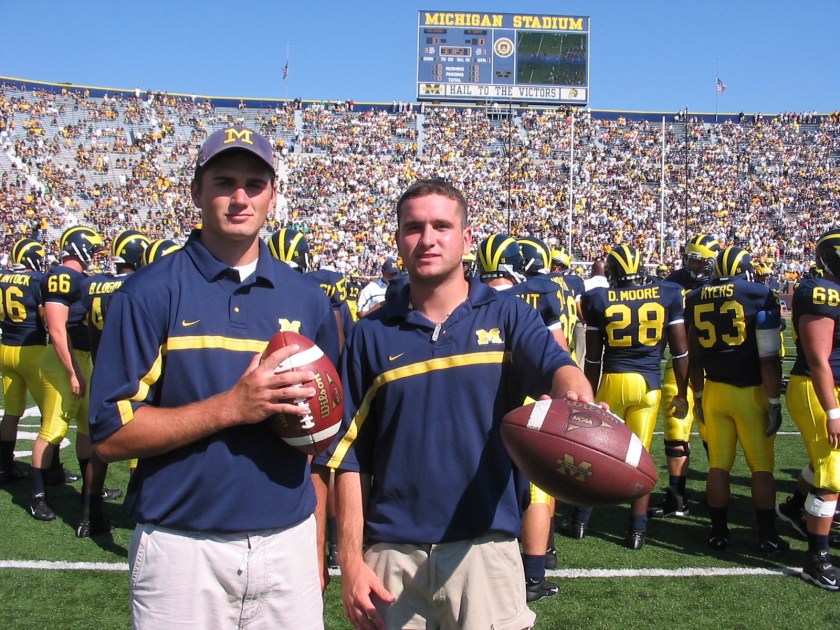
I graduated from Michigan feeling near the top of the food chain as a part of Michigan football, put up and on the field for ESPN/ABC Sports and a member of swag-centric Beta Theta Pi. My competitive spirit was at a high, that is, until it became time to get a job. I didn’t have those players I was close with signed, so I had to find another way in.
On the field, pregame at the Big House as a Manager.
I landed in a New Orleans rebuilding from the wrath of Katrina two years after the fact making a hot $17,500 as the newest Inside Sales member for the New Orleans Hornets, who had just quietly arrived back from a positive hiatus in Oklahoma City. I had the sales pedigree and heralded Game Face Academy training, but that didn’t change that all the phone pounding equating to hearing:
He/she has relocated/died because of the storm/we’re rebuilding/who are the Hornets?
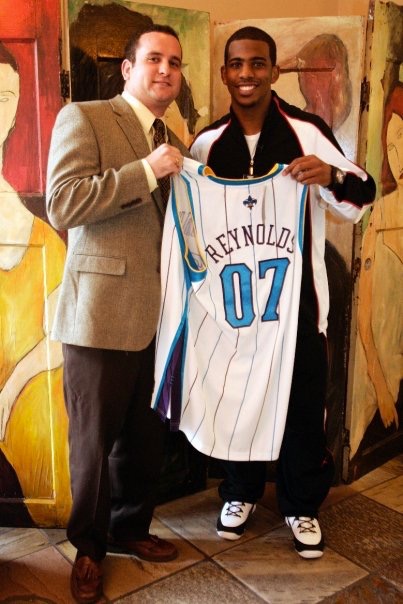
To couple that up, the group was out at our favorite bar Lucy’s after the 2nd game of the season. Spirits are high, until someone said something to the VP of Ticketing’s wife, a punch was thrown and we were out a VP and Director the next day leaving a skeleton staff. We were last in the NBA in attendance and notably, Mark Cuban called out our efforts (of which I called him out on, getting him to successfully acknowledge after an MIT Sloan Sport Analytics panel in 2012). We kept at it, took what we could get, and got some nice publicity by hosting All Star Weekend (which allowed my to sit courtside as a seat filler for Magic Johnson). The team was playing outer-worldly and Chris Paul was becoming the star he is now in leading the group.
The buzz over the Bees had caught on leading into playoffs and everybody wanted in. I was told my promotion was coming for some time and it finally did (less than 1/2 of Inside Sales reps get hired full-time traditionally). Our numbers and demands were huge as we took on the NBA’s most-gracious benefit (“Lagniappe” – Cajun speak for extra value) program, we had a great president in Hugh Weber who instilled a community culture in the mix and everything started clicking. We targeted Mark Cuban on our weekly sales contests as the face on the dartboard and the team finished 2nd in the Western Conference. We got the chance to “stop the flop” in the 1st round against Cuban’s Mavericks and our fans made sure he heard about it in his seats near the bench as we won the first playoff series since the team’s move to the city in 2001-2002. We had the vaunted Spurs on the ropes and a season ticket holder had my plane ticket booked for some love on Western Conference Finals tickets against the Lakers. Despite the series slipping away, the Hive rocked like it never had before with decibels maxing out like at the crazy Superdome across the street.
Despite the turnaround, the team had a legislative agreement to break its lease if fewer than 14,735 fans per game came out to support the team. Would we be back in OKC, where the place sold-out within days? San Diego? The new Sprint Center in Kansas City? Pressures were sky-high to hit that while finding a way to generate 10k new season ticket holders in a market with the constraints of a poor market largely ignored by our country’s decision-makers during a time of unmatched need.
Well, the grind paid off. Not only did we hit our marks, but we pushed and broke the NBA record for new full season tickets sold (a mark held previously by the Baron Davis led Golden State Warriors) – a monstrous jump from under 2,000 full season equivalents to 12,000 from year-to-year.
Celebrating an NBA record campaign with Chris Paul (CP3)
Despite the least amount of tenure and local connections (I knew 1 person in New Orleans before moving there) – I outsold the lot. $2 million produced, including potentially having to see, know and service over 700 people in the house at any game. Like those other top producers that got promoted to manager, I thought I was ready for that. I bought my dream car in cash – a black IS 350 Lexus. I flew my brother down for the cruise we won for hitting the record. I was living too fast and too hard, getting in anywhere in town, living wildly in a city with a constant party environment. My head had swelled, it had caught up to me before I knew it and I found myself back to square one, without a job.
I had opportunities to sell for the top potential major league organizations but instead regrouped, dropped off the map to put work into my GMATs and opted for grad school. Law school and the JD/MBA’s of the world were appealing, but it was late in application season. Dr. Bill Sutton, who helped start the NBA’s lauded Team Business Marketing & Operations (TMBO) department under Commissioner Stern suggested building on successes for any host of potential teams over going back to grad school, but I was determined that a grad degree was what I needed to get ahead. I then accepted a Graduate Assistant position to mentor an outsourced sales staff for the Memphis Grizzlies while pursuing an M.S./M.B.A. at the University of Memphis, where I thoroughly enjoyed teaching the ins-and-outs of helping students learn the ropes of what an official relationship with a major league team equated to, while leading a national Case Cup championship extracurricularly with “Operation BobSTATS.” In the process, we produced a 15x revenue multiple while helping place aspiring sports business pros nationwide from the program and Sport Sales Combine. Memphis wasn’t all glitz and glamour as I lived in a roach-infested place and market in need of a lot of uplift. Again, another major communication snag was realized when I demanded just average treatment while getting my car serviced – but at the wrong place (a key sponsor of the team).
With my University of Memphis Case Cup Champion Team and “Coach” Dick Irwin
Another move was in order and I found myself passing up a great opportunity to sell for the World Series Champion San Francisco Giants (who’s VP in Russ Stanley is the most legendary in the ‘biz, 2 more “even year” rings to come) to move up the importance ladder (or so I thought) in sponsorship, the nation’s capitol and a top 50 global M.B.A. program in G.W. Reality set in hard with 18 credit hours of night classes, 3 hours of D.C. traffic a day and a demanding unpaid internship of which I was putting 6 days a week into. Everybody and their sister with an Ivy League degree wanted into sports in D.C. and rights holders capitalized on this potential for cheap labor for the sake of “experience.” Warning bells should’ve been ringing when I heard “internship” and not “job” during recruitment. I graduated super-fast-tracked with two grad degrees in just over two years thanks to a back-breaking schedule allowing my a few hours of sleep at night after school and internship requirements were over.
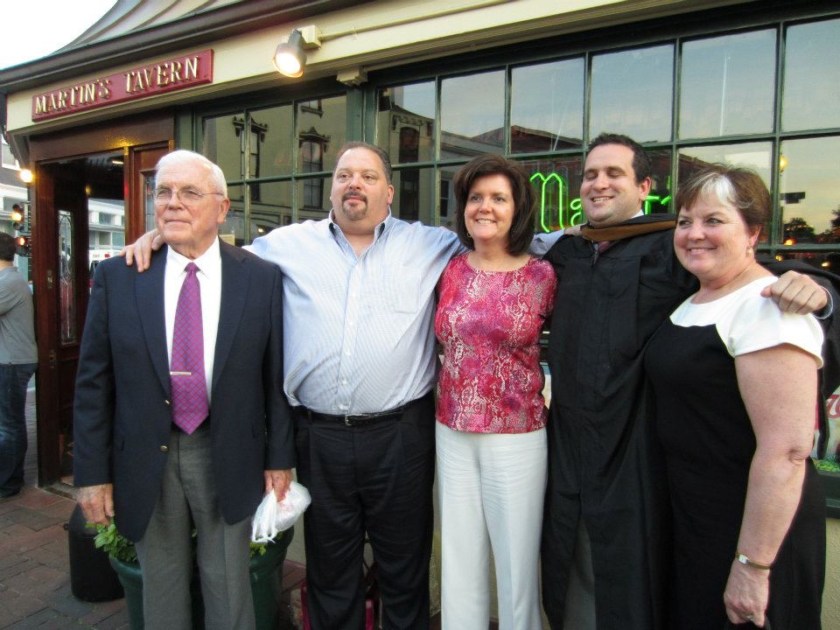
With family after M.B.A. graduation in D.C. – including my grandfather and motivation for this platform.
I was left out to dry, though: square 1 when it came to jobs and had to move home to minimize the student loan burn I had taken on and was making no traction despite the pedigree. Months later, I set up an NYC stay with a school friend and meetings at the NFL League Office on draft day 2012 among others, which spurned other interest. I picked up IMG College’s Ticket Solutions founder at the airport and sat down to discuss becoming Pitt’s Ticketing GM, drove back to Michigan and flew to Utah the next morning for a few hours. I couldn’t wait for the property to get signed and found myself again a transplant to a strange place, taking a pay cut from my pre-grad school days in the process.
My grit was put to the ultimate test day-in and day-out. The results were there on a large-scale as I got to shape a minor league game-day experience to the tune of production unmatched going years back while influencing the next generation, bumped my partnership average to nearly $100k and 3 years per deal at a top league property despite smallest market, but never received the all-important recognition or validation (which costs nothing). More valuable lessons in leadership learned.
Luckily, I settled down with a girl for the first time who spent her life helping people. Things had been re-framed for me and I realized how important it was to not only acquire work experience and monetary or physical resources, but more so positive life experiences, especially those that could be passed on for the benefit of others and myself in turn.
Like Joe eventually found out, life is not about stuff, publicity or fame. Be real, remember where you were, who you are and what got you there, live to maximize your experiences in the world, share your “box” and you’ll leave a lot more fulfilled.
The state of our economy has pivoted in a big way. My story and strategic recommendations.
After a happy holiday season back on the home front, I returned to the office and found myself suddenly unemployed and lucky I didn’t pull the trigger on buying my first place. Despite contributing millions to the company’s bottom line, I was sent packing in preparation of a major recent legislative decision: the United States Department of Labor’s changes in the Fair Labor Act (FLSA) basically doubling the salary required for exemption from overtime pay requirement.
What the U.S. government initially intended to have benefit the employees of the country proved quickly capable of doing the opposite. The legislative decision will have profound effects for employers and employees in every sector. I gave up the chance to follow in my grandfather’s steps in playing collegiate football at his alma mater, instead choosing to go to the University of Michigan and get involved in the business side of the sports industry, which has largely operated on a pay / volunteer to play system – especially for those looking to get an initial foot in the door and possibly a salaried job. 13 years, three degrees, countless unpaid internships, and five sports later, I have seen all sides of the system that capitalize on a huge surplus supply of candidates hungry to sacrifice for the sake of experience in pursuing a life passion. Operating budgets outside of player-related expenses are shoestring.
Our shared economy had already been skewing towards the freelancer, intern, or (fill in the blank) way to avoid paying a minimum annual salary of $47,476 of which up to 10% of that can come from commissions. The game has now changed in a big way especially for those regularly putting in 40+ hours per week or tied to commissions and lofty revenue goals. In sports, this affects everyone in a big way by threatening profits. Yes, winning may be the goal, but it is still a business.
Gone are the days a salesperson would pick up a phone book to sell. The NBA’s consulting arm, Team Marketing and Business Operations (TMBO), launched in 2000 by the likes of Bernie Mullen, Bill Sutton, and others under the direction of commissioner David Stern. 16 years later, it is still setting the industry standard for best practices by compiling, analyzing, developing, and communicating winning ways to generate results to all teams. Despite convergence, when it comes to sharing and training, the standard and disparity between leagues are still vast along with revenue disparities largely due to differences in media rights,another dynamically evolving area of concern for organizations.
Collegiate athletic departments have even more of an issue because they are oftentimes public institutions that cannot legally pay commissions and operate under uniquely governed legislative circumstances. Where will those hundreds of thousands of extra dollars come for those hundreds of small schools? The answer is grim: more sports will be cut while scholarships and jobs are lost.
Sports and sales in general will have to pull best practices of training, onboarding, and technology from other industries to become more strategic. Proven practices include maximizing the number of two hour blocks without distractions or diversions. Prioritizing one’s day with the most important tasks early, check email twice per day at 10 and 4 and schedule 2 hour blocks to get in rhythm on calls. Schedule outside meetings on one day or early/late in the day in coordination with commute. Eliminate/trim meetings and being on the clock on game day unless necessary.
“Frankenstein” solutions involving a mishmash of workflow technology will no longer work because the returns for the employees and organizations will be inefficiently surmised. Knowing this, one company I have chosen to get involved with isSponsorship Buddy, which pulls best practices of marketing automation, cloud services, and project management to rights holders and clients alike into one intuitive platform. Such a solution has proven to take staffs from reactive and day-to-day to strategic saving thousands of hours while providing process transparency and great calculated ROI / ROO.
On the surface, average salaries are sure to rise in correspondence, however, the ramifications will be widespread and force us all to become more calculated and strategic. How will you adapt?
If you have caught on to any outside or developing trends, tools, or techniques to best capitalize on the circumstances, I encourage you to share them here.



 TRUE NORTH TEAM CONSULTING