It’s like a bad sequel. Groundhog Day: Return of Ned Flanderson (sans Bill Murray).
Just when you thought we were turning the corner to stop the gore and the killer had disappeared, we stumble, trip and allow for the villain to catch back up.
We have now entered into the eye of the storm. It’s quiet. Too quiet. And peaceful. But just you wait.
Experts and past leaders knew a pandemic was well within the cards. Luckily, we were prepped for past threats in SARS and Ebola. When the world watched China and Europe get decimation, we hesitated, thumbed our nose and got crushed.
Instead of a World War II-like rallying behind our leaders and mission, our Fake News fragmentation and direction for states to figure it out independently kicked in.
Sadly, the fact that it’s a crucial election year and prospects of a depression took precedence over public health and getting mass testing and herd immunity to where it needs to be.
“Liberation” of our freedoms, opening up non-essential businesses and protesting from close distance is the obvious death trap. Just ask John from Ohio. Oh wait…
No, we won’t save ourselves from UV light or drinking bleach. Please don’t try it (although do go outside – sunshine helps your mental psyche, although it won’t defend much against viruses).
The U.S. (and much of the world similarly) has now far eclipsed the quickest unemployment rate drop. Time and decisions made by all of us will tell whether we eclipse the peak rate of 24.9% during the Great Depression. Hopefully those affected will learn valuable new skills and trades in the meantime while growing relationships at home to evolve and come out of this stronger.
The economy is vital to us all, but we have to trust the scientific experts and the math (see Domo’s live trend visuals). A few weeks of apprehensive business openings isn’t going to be worth the collateral damage we face by being premature and negligent.
Chances are, many more of us have had it than we know. We need mass testing and antibody testing to tell us that as and we still don’t understand what level of exposure (if possible at all) we need to have had to mitigate the threat of a second mutated bout.
We’re working feverishly to enable a vaccine but best case scenario to get one is by almost all accounts is a year from now – around April 2021. Then it has to be mass distributed to the public.
Life as we knew it in terms of going to the flights, concerts, games, bars and restaurants we so loved won’t be the same. We’ll have to adapt to the new normal, even after the vaccine.
We are seeing heroes and valiant, selfless acts happen all around us. It’s the medical, grocery, delivery workers and average Joes going to get groceries for their elderly neighbors that are making the difference and deserve to benefit when the dust settles.
If we’ve learned anything through this, it’s the danger of not educating and equipping the poor and ignorant. If we don’t give everyone access to accurate information, health care and the means to work and live, everything else is threatened. Billionaire Mark Cuban (story of past encounters with him to come) has been a voice of reason for the people, making a public play for trickle-up vs. trickle-down economics.
Maybe we will swallow our pride and step up together when it counts.
Regardless, the shark will be stalking the shores and connected rivers beneath the surface.
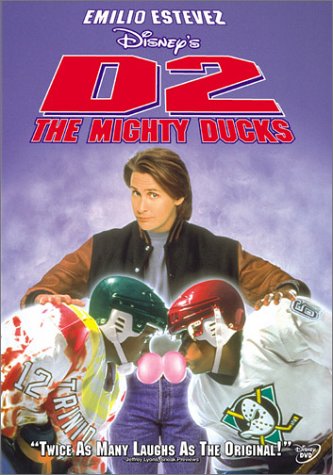
I recently queued up D2: The Mighty Ducks. Regardless of whether you played or liked hockey, my generation beloved the Mighty Ducks movies as kids. In a tumultuous time like this one, consensus towards the greater good is seemingly impossible. We can learn a lot by looking back on the once lovable loser Minnesotan kids, who banded together with others of all shapes, colors and sizes from different corners of the U.S. to defeat the bullies of Iceland in the Junior Goodwill Games finals after Coach Bombay centered himself as a leader. It wouldn’t have happened without believing in the power of instilled confidence.
Personally, I grew up in an achievement-oriented household where I was encouraged to participate (and well) in all kinds of activities. Some I didn’t like ie. choir and piano. Others I loved ie. sports – I played four competitively into high school, usually among the top performers on my teams. Hockey would’ve been one had I moved back to Minnesota sooner (my friends were deep into travel hockey by 4th grade).
My folks went to top universities and academics always came 1st – getting into a great school was priority #1 and I had only a decent handful of B’s into high school. I had an outgoing personality and friend groups beyond just the “popular” group. Despite all the accolades and activity time, I often felt alone and a failure – especially in high school. If it weren’t for my parents always having my back though, where would I be?
Granted, some of this might be the result of a competitive, achievement-oriented culture. Sure, there were plenty of good teachers who pushed and encouraged. Coaches on the other hand, not so much. The dads were more often than not solid, albeit biased towards their kids (as mine was). Winning was common and the times were loose and fun. It was into high school that the paradigm shifted. If you didn’t dedicate yourself to the “system” of that specific sport and all the workouts and family politics year-round, then you were missing out regardless of talents demonstrated. Lesser “system” athletes focused on 1 sport and were anointed “golden boy” status over others successfully competed for their school in multiple competitive sports.
One would think that high school coaches (and teachers) are there because they care about giving back and developing life achievers. Egregiously, as far as many were concerned, it was all about their ego and attitude coming from doing it the same way for awhile, their image or winning at small fill-in-the-blank hamlet town. “I could care less about what you’ve done or who you are, it’s my way or the highway.” Small-minded small-ball!
I remember going into horrific shooting or hitting slumps. I would go home, shovel off the snowy driveway and night and shoot until I couldn’t see or get my dad to pitch until he couldn’t throw. It didn’t matter though as next to ZERO encouragement or support was offered from coaches. How are you going to succeed when you’ve got it stuck in your head that if you miss ONE shot, you’re back on the bench?
I went to Duke basketball camp two years in a row around national championships and learned from the best and a master motivator in Coach K. Despite Duke being the model for our “system,” I ended up losing out on the last varsity roster spot to the handicapped “system” guy. I walked off after not even logging a play in the game for my last playoff baseball game after starting every career game. Can you get any more of a slap in the face?
The teenage years are the most volatile and when you’re offered nothing but negativity from those that are supposed to lift you, how can you succeed?
Fast forward to college. I was DONE with high school and the work paid off as I got into every school I applied – except getting waitlisted at the one I thought I was meant for (of which my dad attended). Gone went the nurturing offered by the home-front and in came freedom and autonomy of quasi-adult life. College offered the ability for anyone to re-invent oneself.
The times were exciting but the bar was set for failure – proven achievers used to near 4.0’s like myself now found themselves in the “C” range, barely scraping by. I remember taking a physics class of which I had no business being in having not taken calc and getting something in the neighborhood of an 8 out of 60 on an exam despite serious studying! My GPA after the 1st semester was near suspension level. I found out about the verb “South Foresting,” from the parking garage famous for university suicide, the ultimate failure feeling put into action.
I pushed it to the limit, developing association with the “leaders and best” among the “Leaders & Best,” in the Mud Bowl and Greek scene and our acclaimed football program, and lots of time not only on the beer pong table, but in the and classroom and library. I started to find myself while I kicked it into gear and started competing toe-to-toe in everything on campus and internally started to realize was that I could hold my own (despite the top-notch acumen of the competition). Confidence brimmed internally and externally and peaked – I was on T.V. on the sidelines, and in the “alpha” social, competitive limelight otherwise. I had not only survived, but thrived in many senses and graduated with a double major.
Pro
The door into the sports industry is revenue generation and all of a sudden, re-invention had to happen again. A 99% rejection outcome became the norm and the hurdles were steep in Inside Sales – the “chop shop” of weeding people out. I buckled in, outworked and out-performed my peers after some trying, tough times in a faraway, disaster-ravaged market of which I knew 1 person. I quickly learned what having no culture and a boss departed for punching someone in front of his employees to understanding what a thriving, motivating, positive team-oriented culture felt like.
Fast forward ten years and two grad degrees of which I pushed myself to the limit further, It’s taken many sacrifices, disappointments and failures. Every B-school will pound in how and stress the importance of leadership and “culture” in the workplace. Interviews for those impossibly in-demand positions too often yield comes with a boxed, burnt out “work hard play hard” answer when asked about culture. Failure to read the warning signs equated a horrific toxic work environment of which I was thrown in and left for dead, getting picked at by the buzzards daily, where the standard of excellence was driven by egotism and narcissism over any sense of new ideas, morality or ethics. Put up, shut up and fall in line the sake of the deal.
I’ve now learned the hard way and realized what Michael Thompson learned over 38 years – confidence isn’t about self-promotion, it’s about listening, and feeling comfortable applying and promoting others’ winning strategies to build their trust.
In D2, Gordon Bombay went “Hollywood” and got too caught up in the glam and the image, forgetting who he was and what he had learned along the way. Before it was too late, he traded the suit for the Ducks jacket and got back to where it began. He encouraged his kids to do what they did best, believing in each in the highest pressure situations despite dirty play and tactic traps laid by the opponent. In the end, the team banded together and won it all for the good-ole U-S-of-A thanks to being confident in who they were and what they could do.
Life isn’t a Disney movie or a sport, but the message is one we can all learn from. Believe in those around you and express encouragement – we can all benefit in the end so much more than maintainging a fixation on our own self-serving agendas.
D2: THE MIGHTY DUCKS, Emilio Estevez, Colombe Jacobsen, Shaun Weiss, Matt Doherty, Marguerite Moreau, Joshua Jackson, Justin Wong, etc, 1994.
Transparency spooks and how it’s moving forward in football, business and life. Apocalypse now?
If you’ve missed me of late, I’ve been blogging about the latest sponsorship news and best practices. We also took a quick “secret shopper” trip to the thriving metropolises of Nephi/Ephraim/Nebo, Utah, stopping at one of the more said-to-be haunted destinations of the area in Leslie’s Family Tree where the Mormon pioneers of yesteryear clashed with the Native Americans. I’ve done the research and I’m a believer in transparency – which goes beyond unexplainable paranormal phenomenon, but is increasingly and readily applicable in the sports business and our collective impending future.
“The Game” & Beyond
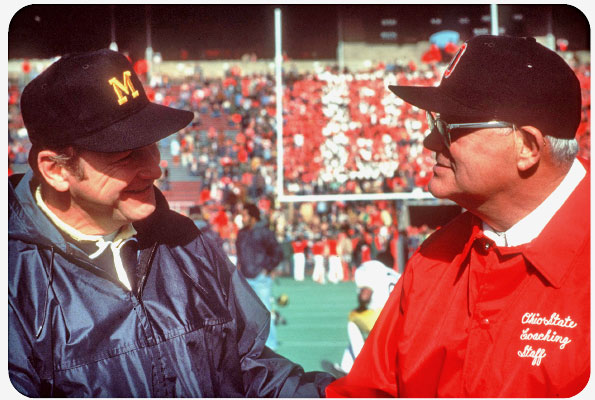
I just got off the phone with a friend and client of mine in Glenn “Shemy” Schembechler, son of the legendary Michigan coach Bo. Bo learned everything he knew while coaching under Woody Hayes, who would later become his biggest rival. Both Michigan and that one state school in Ohio largely played the same way for many years. Everyone knew that both teams were most likely to run the ball on 1st and 2nd down and throwing if need be on 3rd down. No frills or surprises, they’re going to rely on brilliant strategy and execution to beat you with tough, talented athletes who believe in their schools’ and coaches’ native credos. Stop it if you can (sorry, the numbers say you likely won’t as both schools are at the top of the alltime recordbooks).
Shemy, who soaked in all that football leadership along the way and utilized it as an NFL scout, has launched GES Advisory Company, designed to utilize the aforementioned institutional knowledge to benefit aspiring high school football players. His goal is to give high school athletes the chance to play the sport they love in college (he can be reached at: gesadvisory@gmail.com). Compared to other recruiting services, he goes much deeper when it comes to taking athletic measurements, gauging mental “make-up” and academic interests, and finding a scholastic fit from the “Power 5” schools on down the collegiate chain. 100% success ratio. To maximize effect from both a hand-to-hand combat success coupled with today’s demands of information transparency, he’s partnered with Sport Testing, a Canadian company with hockey (including NHL) success stories to build on, patent-pending and coming to you soon. Sport Testing, “the leading provider of sport specific player testing and a developer of athletic assessment technologies,”has developed equipment shown to be the most accurate in gauging athletic performance. It also has created a database to share this data, serving both the athletes and properties.
Man, I wish it existed back when I was playing! I was always in-season playing a different ball sport and wasn’t taught the right track technique to run a good 40. My recruiting service was my grandfather with our team highlight VHS tape knocking on the doors of his alma mater to get me a meeting (not that I would’ve made a different school choice). 5 Star football players who get a verbal offer don’t realize that it has no legal binding, nor does that official offer they received. Now, the gap is being bridged.
The Interview
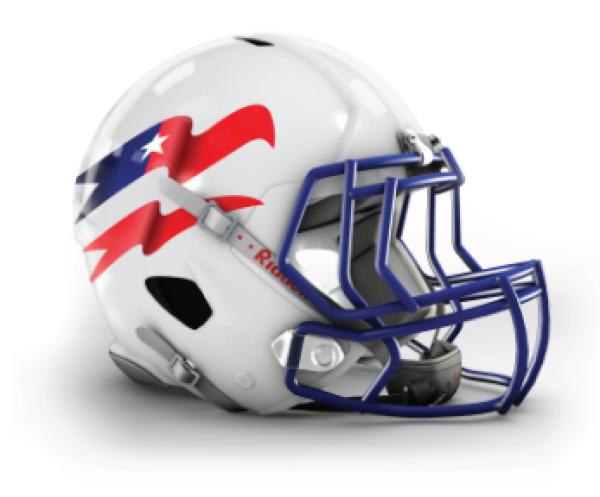
I just mustered the best 30 minute phone interview perhaps I’ve done to date with Project FANchise to be President of the Salt Lake Screaming Eagles football team by mapping out and checking off what I deemed were the success criteria necessary for the position of my dreams. With the CEO in call 1 before he had seen my resume. I didn’t do it to work with just another minor league team – this is the 1st ever fan run team. Everything has been voted on by the fans from the city (they’ll be playing at the Maverik Center, where I worked and of which I had the endorsement of the President I was under) to G.M., head coach, logo and even play calls.
This group (an entrepreneurial mix of tech entrepreneurs, digital, NFL and sport business vets) has crowdfunded opportunities for fans all over the world to get involved with the Screaming Eagles. Yes, the opposing team might know what’s coming, but can they stop it? The point is, it opens up the dream of getting involved in what you were/are most passionate about to the masses, where the barriers to entry are the most extreme of perhaps any industry. Typical sports jobs field hundreds if not thousands of resumes per open position. This doesn’t even touch on how hard it is to become a professional athlete nor begin to speak to the struggle to excel once you get in on the business side when you’re making peanuts while competing with the hopes of countless others to be G.M., etc. someday let alone keep your current job.
What Project FANchise is doing is to utilize digital transparency that social media has provided us all to develop a competitive advantage – it’s giving live “recruiting tape” to not only to the players, coaches and G.M.’s looking to make a pro impact and move up the ranks, but also to Joe Schmo the fan as well (who can be G.M. for a day for $500). As the Bo’s of the world have stated, “those who stay will be champions.” Brilliant execution can open up big doors of opportunity.
All over the place, transparency has become apparent and the effects are rampant. It’s what went into the food we eat and the companies making it. It’s social media. It’s the manual processes in life that are being replaced by automatic processes that can share valuable data seamlessly. We’re starting to realize that sitting in traffic for an hour to commute to shuffle papers and sit in abusively boring meetings all day isn’t always the most productive or efficient way of doing business.
According to the Martin School at Oxford, 47% of today’s jobs in the U.S. will be replaced by artificial intelligence and robots within the next twenty years. Like the farmers of yesteryear, collaboration will likely create new opportunities.
Or, maybe Terminator was correct and machines are coming to bring about the apocalypse.
Maybe I wasn’t named the 1st President of the Salt Lake Screaming Eagles (someone else got the gig who had been a Minor League Baseball CEO). I know where I align when it comes to complaining vs. solving come the next apocalypse. How about you?
Maybe you’ll become the next lost soul tragically left behind to walk between worlds.
The Terminator fighting the apocalypse with automatic weapons
Anyone that came across Joe Theisman, either as a fan, personally or working in the ‘biz would agree. He was a first-class piece of work (to put it nicely). Everything about him reeked of arrogance – his personality, his comments, his attitude, even his steakhouse. He won one Super Bowl in a town without too many, and it’s safe to say that all the notoriety over the years made his head swell.
Sadly, this is not a phenomenon unique to Joe, who believably has made a remarkable turnaround in self-realization. Modern society puts our modern day gladiators of sports or earnings on a pedestal and it has a societal effect.
I, Charles Reynolds, had even caught the bug and this is my story.
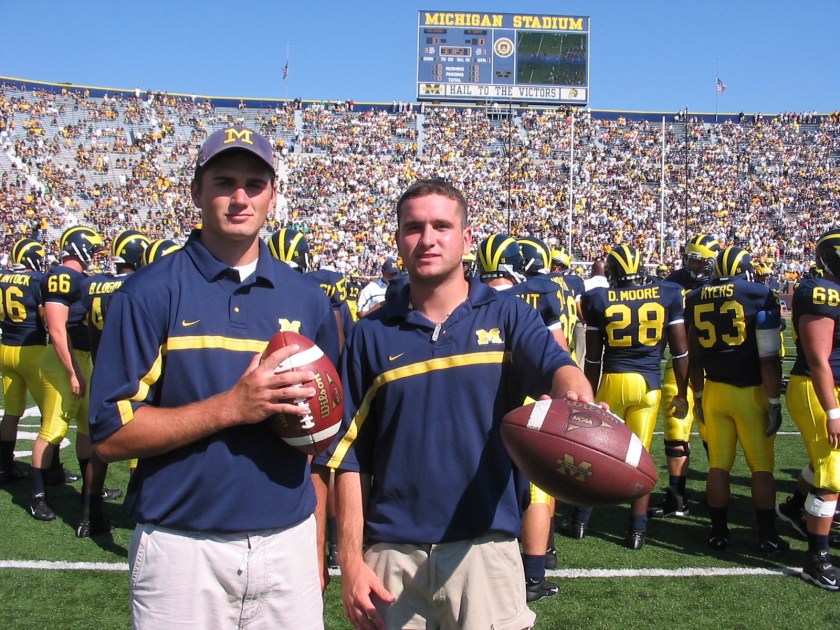
I graduated from Michigan feeling near the top of the food chain as a part of Michigan football, put up and on the field for ESPN/ABC Sports and a member of swag-centric Beta Theta Pi. My competitive spirit was at a high, that is, until it became time to get a job. I didn’t have those players I was close with signed, so I had to find another way in.
On the field, pregame at the Big House as a Manager.
I landed in a New Orleans rebuilding from the wrath of Katrina two years after the fact making a hot $17,500 as the newest Inside Sales member for the New Orleans Hornets, who had just quietly arrived back from a positive hiatus in Oklahoma City. I had the sales pedigree and heralded Game Face Academy training, but that didn’t change that all the phone pounding equating to hearing:
He/she has relocated/died because of the storm/we’re rebuilding/who are the Hornets?
To couple that up, the group was out at our favorite bar Lucy’s after the 2nd game of the season. Spirits are high, until someone said something to the VP of Ticketing’s wife, a punch was thrown and we were out a VP and Director the next day leaving a skeleton staff. We were last in the NBA in attendance and notably, Mark Cuban called out our efforts (of which I called him out on, getting him to successfully acknowledge after an MIT Sloan Sport Analytics panel in 2012). We kept at it, took what we could get, and got some nice publicity by hosting All Star Weekend (which allowed my to sit courtside as a seat filler for Magic Johnson). The team was playing outer-worldly and Chris Paul was becoming the star he is now in leading the group.
The buzz over the Bees had caught on leading into playoffs and everybody wanted in. I was told my promotion was coming for some time and it finally did (less than 1/2 of Inside Sales reps get hired full-time traditionally). Our numbers and demands were huge as we took on the NBA’s most-gracious benefit (“Lagniappe” – Cajun speak for extra value) program, we had a great president in Hugh Weber who instilled a community culture in the mix and everything started clicking. We targeted Mark Cuban on our weekly sales contests as the face on the dartboard and the team finished 2nd in the Western Conference. We got the chance to “stop the flop” in the 1st round against Cuban’s Mavericks and our fans made sure he heard about it in his seats near the bench as we won the first playoff series since the team’s move to the city in 2001-2002. We had the vaunted Spurs on the ropes and a season ticket holder had my plane ticket booked for some love on Western Conference Finals tickets against the Lakers. Despite the series slipping away, the Hive rocked like it never had before with decibels maxing out like at the crazy Superdome across the street.
Despite the turnaround, the team had a legislative agreement to break its lease if fewer than 14,735 fans per game came out to support the team. Would we be back in OKC, where the place sold-out within days? San Diego? The new Sprint Center in Kansas City? Pressures were sky-high to hit that while finding a way to generate 10k new season ticket holders in a market with the constraints of a poor market largely ignored by our country’s decision-makers during a time of unmatched need.
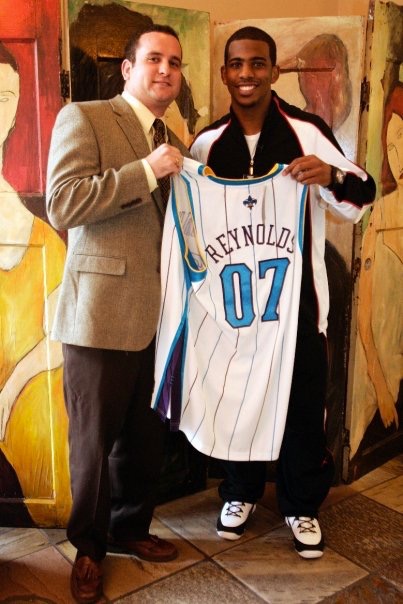
Well, the grind paid off. Not only did we hit our marks, but we pushed and broke the NBA record for new full season tickets sold (a mark held previously by the Baron Davis led Golden State Warriors) – a monstrous jump from under 2,000 full season equivalents to 12,000 from year-to-year.
Celebrating an NBA record campaign with Chris Paul (CP3)
Despite the least amount of tenure and local connections (I knew 1 person in New Orleans before moving there) – I outsold the lot. $2 million produced, including potentially having to see, know and service over 700 people in the house at any game. Like those other top producers that got promoted to manager, I thought I was ready for that. I bought my dream car in cash – a black IS 350 Lexus. I flew my brother down for the cruise we won for hitting the record. I was living too fast and too hard, getting in anywhere in town, living wildly in a city with a constant party environment. My head had swelled, it had caught up to me before I knew it and I found myself back to square one, without a job.
I had opportunities to sell for the top potential major league organizations but instead regrouped, dropped off the map to put work into my GMATs and opted for grad school. Law school and the JD/MBA’s of the world were appealing, but it was late in application season. Dr. Bill Sutton, who helped start the NBA’s lauded Team Business Marketing & Operations (TMBO) department under Commissioner Stern suggested building on successes for any host of potential teams over going back to grad school, but I was determined that a grad degree was what I needed to get ahead. I then accepted a Graduate Assistant position to mentor an outsourced sales staff for the Memphis Grizzlies while pursuing an M.S./M.B.A. at the University of Memphis, where I thoroughly enjoyed teaching the ins-and-outs of helping students learn the ropes of what an official relationship with a major league team equated to, while leading a national Case Cup championship extracurricularly with “Operation BobSTATS.” In the process, we produced a 15x revenue multiple while helping place aspiring sports business pros nationwide from the program and Sport Sales Combine. Memphis wasn’t all glitz and glamour as I lived in a roach-infested place and market in need of a lot of uplift. Again, another major communication snag was realized when I demanded just average treatment while getting my car serviced – but at the wrong place (a key sponsor of the team).
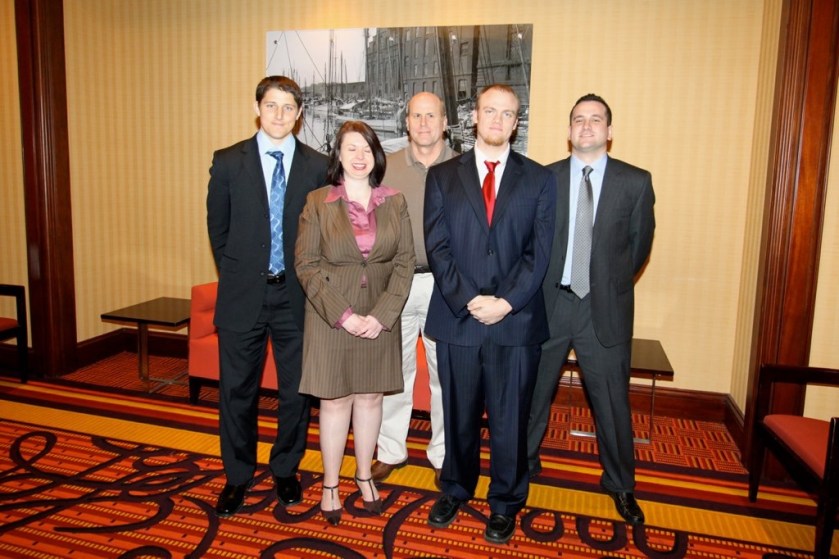
With my University of Memphis Case Cup Champion Team and “Coach” Dick Irwin
Another move was in order and I found myself passing up a great opportunity to sell for the World Series Champion San Francisco Giants (who’s VP in Russ Stanley is the most legendary in the ‘biz, 2 more “even year” rings to come) to move up the importance ladder (or so I thought) in sponsorship, the nation’s capitol and a top 50 global M.B.A. program in G.W. Reality set in hard with 18 credit hours of night classes, 3 hours of D.C. traffic a day and a demanding unpaid internship of which I was putting 6 days a week into. Everybody and their sister with an Ivy League degree wanted into sports in D.C. and rights holders capitalized on this potential for cheap labor for the sake of “experience.” Warning bells should’ve been ringing when I heard “internship” and not “job” during recruitment. I graduated super-fast-tracked with two grad degrees in just over two years thanks to a back-breaking schedule allowing my a few hours of sleep at night after school and internship requirements were over.
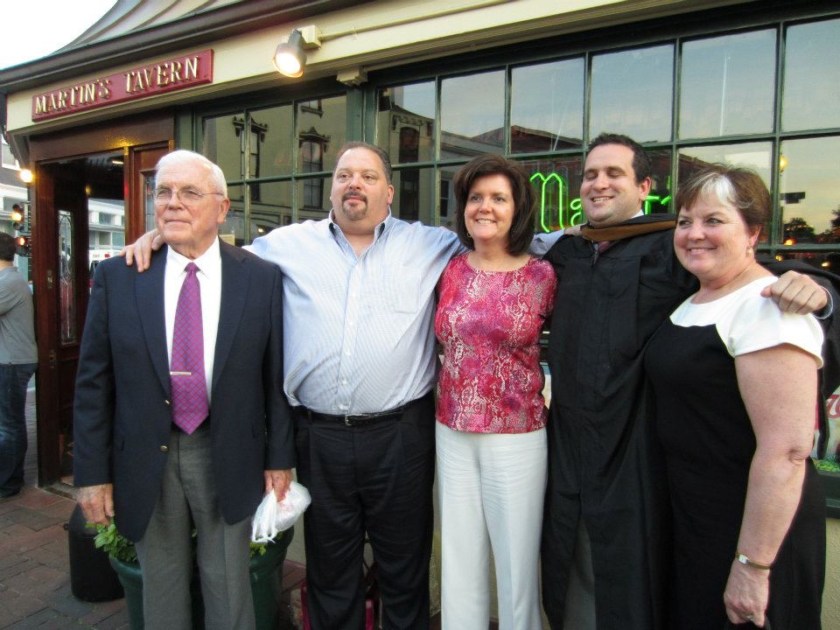
With family after M.B.A. graduation in D.C. – including my grandfather and motivation for this platform.
I was left out to dry, though: square 1 when it came to jobs and had to move home to minimize the student loan burn I had taken on and was making no traction despite the pedigree. Months later, I set up an NYC stay with a school friend and meetings at the NFL League Office on draft day 2012 among others, which spurned other interest. I picked up IMG College’s Ticket Solutions founder at the airport and sat down to discuss becoming Pitt’s Ticketing GM, drove back to Michigan and flew to Utah the next morning for a few hours. I couldn’t wait for the property to get signed and found myself again a transplant to a strange place, taking a pay cut from my pre-grad school days in the process.
My grit was put to the ultimate test day-in and day-out. The results were there on a large-scale as I got to shape a minor league game-day experience to the tune of production unmatched going years back while influencing the next generation, bumped my partnership average to nearly $100k and 3 years per deal at a top league property despite smallest market, but never received the all-important recognition or validation (which costs nothing). More valuable lessons in leadership learned.
Luckily, I settled down with a girl for the first time who spent her life helping people. Things had been re-framed for me and I realized how important it was to not only acquire work experience and monetary or physical resources, but more so positive life experiences, especially those that could be passed on for the benefit of others and myself in turn.
Like Joe eventually found out, life is not about stuff, publicity or fame. Be real, remember where you were, who you are and what got you there, live to maximize your experiences in the world, share your “box” and you’ll leave a lot more fulfilled.






 TRUE NORTH TEAM CONSULTING